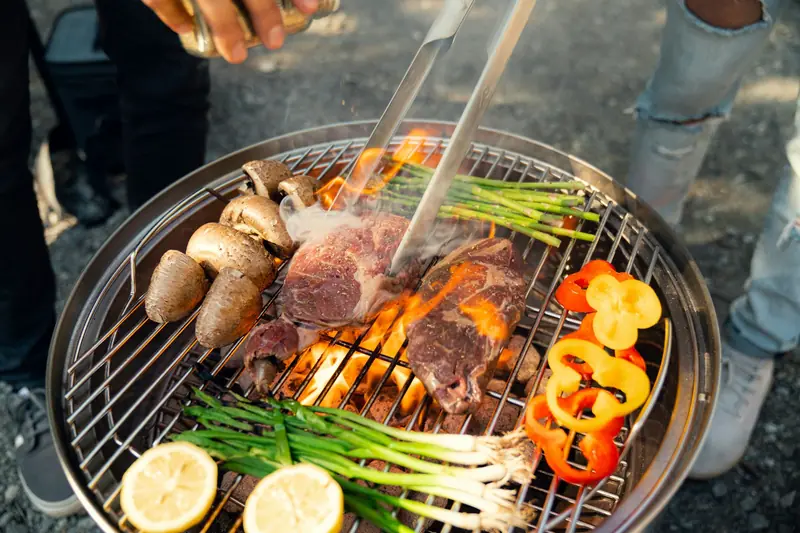
Best Portable Grills for Tailgating and Camping
A portable grill has to cook well enough to be worth carrying and pack small enough to come along. The trade-offs are weight against cooking area, propane convenience against charcoal flavor, and how fast it sets up in a parking lot or campsite. This guide is for tailgaters, campers and anyone with a balcony that allows a small grill.
Jump to section
What we look for
Weight and carry design
you carry it from the car, so weight and handles matter more than any cooking spec.
Fuel and canister compatibility
fuel decides what you need to pack and where you can buy more.
Cooking area
the grate decides how many people you can feed in one batch.
Heat output and wind resistance
outdoors, wind can rob a small grill of heat; output and burner shielding help.
Setup time
a grill that sets up in a minute gets used; one that needs tools stays in the trunk.
Lid lock for transport
a latch keeps the lid shut and the grease inside while you carry it.
- Sources: manufacturer product pages, manuals and warranty terms, plus CPSC, CDC, NFPA and USDA guidance on carbon monoxide, leak checks and outdoor food safety.
How to choose the right portable grill
Start with fuel, then weight. If the grill will mostly stay on a patio, a full-size gas grill or charcoal grill gives you more for the money.
Weight and carry design
Compare the listed weight, then check how you carry it: a single handle, two handles or wheels. A grill that is a little lighter but awkward to hold is not more portable. Check the folded size as well as the weight, because a grill that will not fit in the trunk beside the cooler stays home.
Fuel and canister compatibility
Small gas grills usually run on small disposable propane canisters, and some accept an adapter hose for a standard cylinder; check the canister type in the table. Charcoal models need briquettes and a safe way to deal with hot ash. Run the soap-and-water leak test on gas fittings whenever you connect a new canister (NFPA via CT.gov). Charcoal brings its own ash problem: NFPA says to let coals cool completely before putting them in a metal container (NFPA via ANSI), so plan for that before you pack up.
Cooking area
Compare the listed cooking area against your usual group. A grate that fits burgers for two will feel small at a tailgate for six. Cook in batches if the grate is small, and check each batch against our grilling temperature chart.
Heat output and wind resistance
BTU figures are maker-stated and a small grill with a tight lid can use its heat well. Look for a lid that closes fully and burners shielded from side wind.
Setup time
Folding legs, a built-in igniter and a regulator that attaches by hand make setup faster. Check the manual for the steps before you buy. Set it up once at home so the steps are familiar when you are in a crowded parking lot.
Lid lock for transport
Look for a lid latch and a grease tray that locks or seals. Let the grill cool before packing it, and never put a warm charcoal grill in a vehicle. Keep children and pets at least three feet from the grill while it is lit (NFPA via ANSI).
Tips for using your portable grill
- Never cook with a portable grill in a tent, camper or vehicle: CPSC warns against burning charcoal in enclosed spaces, and CDC lists portable camp stoves among carbon monoxide sources (CPSC; CDC).
- Keep cold food at 40°F or below in a cooler, and do not leave perishables out more than 2 hours, or 1 hour above 90°F (USDA).
- Pack an instant-read thermometer and cook to the temperatures on our grilling temperature chart.
- Check the rules where you will cook: Massachusetts, for example, requires grills to sit 10 feet from the side of a building unless the maker allows closer (Mass.gov).
- Never leave a lit grill unattended (NFPA via ANSI).
FAQ
Can I use a portable grill in a tent or camper?
How do I check the gas connection?
Brush soapy water onto the hose and fittings and look for bubbles (NFPA via CT.gov; Mass.gov).
How far from people and pets?
NFPA's advice is a gap of at least three feet between the grilling area and any children or pets (NFPA via ANSI).
How do I keep tailgate food safe?
Cold food should stay at 40°F or below, and perishables should not sit out for more than 2 hours, or 1 hour once it is above 90°F (USDA).
Related
-
Buying guide
Best Gas Grills
Burners, cooking area, grates and warranty for propane and natural gas grills.
-
Buying guide
Best Charcoal Grills (Kettles and Kamados)
Kettles and kamados compared on airflow, ash handling, size and weight.
-
Buying guide
Best Outdoor Griddles and Flat Tops
Cooktop size, burners, grease systems and lids for outdoor flat tops.
-
Buying guide
Best Meat Thermometers (Instant-Read)
Read speed, stated accuracy and calibration for instant-read probes.
-
Guide
Grill Safety: Placement, Propane Checks and Charcoal Rules
Placement, the propane leak test, charcoal rules and carbon monoxide.

Get the Grill-Side Card
A printable card with the USDA safe temperatures and an 8-point pre-cook safety check. It costs nothing and is sized to stick on the fridge.